

Ascension of Jesus Christ
What is the Ascension of Jesus?
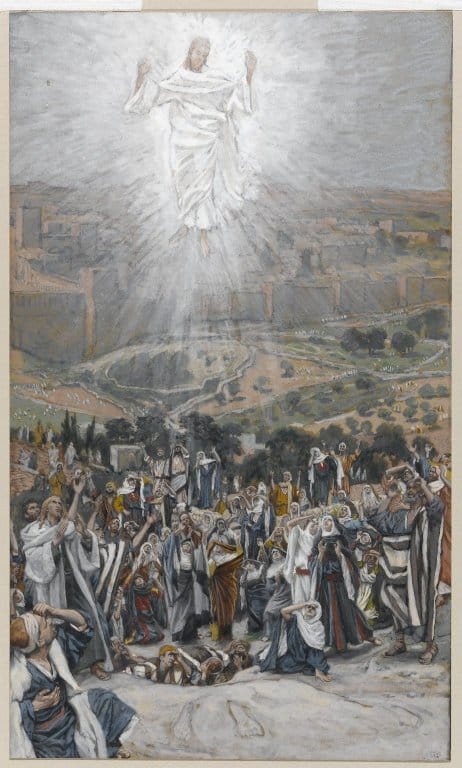
The Ascension of Jesus Christ is the Second Glorious Mystery of the Rosary and one of the most triumphant moments in all of Sacred Scripture. Forty days after His Resurrection, Jesus led His disciples to Bethany, lifted His hands over them in blessing, and was taken up into heaven — completing His earthly mission and returning to the glory of the Father.
This mystery is not only a historical event. It is the moment when Christ, fully human and fully divine, entered into His eternal kingship at the right hand of the Father. When we pray this decade of the Rosary, we are invited to meditate on the authority of the risen Christ, the glorification of our humanity in Him, and the promise He made before ascending — that the Holy Spirit would come and that He Himself would return. The Ascension is a mystery of triumph, commissioning, and great hope.
What is the the Second Glorious Mystery of the Rosary?
The Second Glorious Mystery of the Rosary is the Ascension of Jesus Christ. It is prayed on Wednesdays and Sundays as part of the Glorious Mysteries, which are traditionally prayed at the beginning of the week in honor of the Resurrection and the glorified life of Christ.
In this mystery, we contemplate the moment when Jesus ascended bodily into heaven in the sight of His disciples, forty days after His Resurrection. The Ascension is not a departure but a completion — the fulfillment of Christ’s earthly mission and His enthronement at the right hand of the Father. Through this mystery, we are reminded that the One who suffered and died for us now reigns in glory, interceding for us before the Father.
The traditional fruit of the Second Glorious Mystery is hope in eternal life — the confident trust that because Christ has ascended, He has opened the way for us to follow. As you pray this decade, bring before Him your desire for heaven, your hope in His promises, and your trust that He is present with you even now.
Scripture of the Ascension of Christ
(Luke 24:36-51)
Now whilst they were speaking these things, Jesus stood in the midst of them, and saith to them: Peace be to you; it is I, fear not. But they being troubled and frightened, supposed that they saw a spirit. And he said to them: Why are you troubled, and why do thoughts arise in your hearts? See my hands and feet, that it is I myself; handle, and see: for a spirit hath not flesh and bones, as you see me to have. And when he had said this, he shewed them his hands and feet.
But while they yet believed not, and wondered for joy, he said: Have you any thing to eat? And they offered him a piece of a broiled fish, and a honeycomb. And when he had eaten before them, taking the remains, he gave to them.
And he said to them: These are the words which I spoke to you, while I was yet with you, that all things must needs be fulfilled, which are written in the law of Moses, and in the prophets, and in the psalms, concerning me. Then he opened their understanding, that they might understand the scriptures. And he said to them: Thus it is written, and thus it behoved Christ to suffer, and to rise again from the dead, the third day: And that penance and remission of sins should be preached in his name, unto all nations, beginning at Jerusalem. And you are witnesses of these things. And I send the promise of my Father upon you: but stay you in the city till you be endued with power from on high.
And he led them out as far as Bethania: and lifting up his hands, he blessed them. And it came to pass, whilst he blessed them, he departed from them, and was carried up to heaven. (Luke 24: 36-51)
Understanding the Ascension: Luke 24 Passage by Passage
Luke 24:36-51 describes two important post-resurrection appearances of Jesus and concludes with Christ’s Ascension. This passage illustrates the reality of the Resurrection, the fulfillment of Scripture, and Jesus’ commissioning of His disciples.
1. Jesus Appears to His Disciples (Luke 24:36-43)
As the disciples are discussing Jesus’ earlier appearances, He suddenly stands among them, saying, “Peace be to you” (Luke 24:36). This greeting reassures them, but they are initially terrified, mistaking Him for a ghost. Jesus addresses their doubts by showing them His hands and feet, marked with the wounds of the crucifixion, and invites them to touch Him to prove that He is not a spirit but truly risen in bodily form.
To further confirm His physical Resurrection, He asks for something to eat and consumes a piece of broiled fish (Luke 24:42-43). This act demonstrates that He is alive in a glorified yet tangible body. Through this, Jesus reassures His disciples that His Resurrection is real, fulfilling His earlier promises.
2. Jesus Explains the Scriptures (Luke 24:44-47)
Jesus reminds the disciples that everything written about Him in the Law of Moses, the Prophets, and the Psalms must be fulfilled. This triad represents the entirety of the Hebrew Scriptures (the Old Testament). He opens their minds to understand how these Scriptures point to His death and Resurrection as fulfilling God’s salvific plan.
Jesus explains that it was necessary for the Christ to suffer, die, and rise on the third day and that repentance and forgiveness of sins should be preached in His name to all nations, beginning from Jerusalem. This explanation grounds the disciples’ faith in the Word of God and commissions them to proclaim the Gospel.
3. The Great Commission and Promise of the Holy Spirit (Luke 24:48-49)
Jesus declares the disciples as witnesses to His life, death, and Resurrection. He then promises to send the Holy Spirit, whom He refers to as the “promise of the Father.” The Spirit will empower them to carry out their mission to spread the Gospel to all nations. Jesus instructs them to remain in Jerusalem until they are “clothed with power from on high,” which will occur at Pentecost (Acts 2).
4. The Ascension (Luke 24:50-51)
In the final verses, Jesus leads the disciples to Bethany, lifts His hands, and blesses them. While blessing them, He is taken up into heaven. This act signifies the completion of His earthly mission and the beginning of the disciples’ mission to continue His work. The Ascension marks Jesus’ exaltation, where He takes His place at the Father’s right hand.
Four Theological Themes of the Ascension
- The Reality of the Resurrection: Jesus’ appearance, physical wounds, and eating of fish underscore the bodily Resurrection, a central tenet of the Christian faith.
- Fulfillment of Scripture: Jesus connects His life, death, and Resurrection to God’s covenantal promises in the Old Testament.
- Mission and Witness: The disciples are charged with spreading the message of repentance and forgiveness, empowered by the Holy Spirit.
- Jesus’ Divinity and Authority: The Ascension demonstrates Jesus’ divine nature and His role as Lord over heaven and earth.
Eleven Disciples and Women Who Witnessed the Ascension
Then they returned to Jerusalem from the mount that is called Olivet, which is nigh Jerusalem, within a sabbath day’s journey. And when they were come in, they went up into an upper room, where abode Peter and John, James and Andrew, Philip and Thomas, Bartholomew and Matthew, James of Alpheus, and Simon Zelotes, and Jude the brother of James. All these were persevering with one mind in prayer with the women, and Mary the mother of Jesus, and with his brethren. (Acts 1:12-14 Douay-Rheims 1899 American Edition)
According to Acts 1:12-14, after the Ascension, the eleven Apostles returned to Jerusalem and gathered in the upper room together with the women — among them the Blessed Virgin Mary — and the brethren of the Lord. The naming of these witnesses is not incidental. It establishes the Ascension as a public, verifiable event, witnessed by a community of known individuals. Mary’s presence in that upper room is also significant: the same woman who said *yes* at the Annunciation was there at the beginning of the Church, persevering in prayer with the disciples as they awaited the fulfillment of what her Son had promised.

Feast Day of the Ascension
The feast day for the Ascension of Christ is the Solemnity of the Ascension of the Lord in the Catholic Church and is considered a Holy Day of Obligation. It commemorates the event of Jesus ascending into heaven, as described in Luke 24:50-53 and Acts 1:9-11, and is celebrated 40 days after Easter Sunday. This timing reflects the biblical account of Jesus spending 40 days with His disciples after His Resurrection before ascending.
Traditionally, the Feast of the Ascension is observed on a Thursday, exactly 40 days after Easter, often referred to as Ascension Thursday. However, in some countries or dioceses, the celebration is transferred to the following Sunday to allow more of the faithful to participate and is referred to as Ascension Sunday.
The feast highlights the culmination of Jesus’ earthly mission, His exaltation to the right hand of the Father, and the promise of the Holy Spirit. It also emphasizes the hope of His Second Coming, as proclaimed by the angels in Acts 1:11. Liturgically, the day is marked by readings from Acts 1, Ephesians 1, and the Gospel accounts of the Ascension, along with prayers and hymns celebrating Christ’s heavenly reign.
The Feast of the Ascension is one of the most ancient feasts of the Church, with its celebration dating back to the 4th century. It reminds Christians of their call to live as witnesses of Christ, empowered by the Holy Spirit while awaiting His return in glory.
The Ascension is also inseparable from the broader scope of the Paschal Mystery — the full arc of Christ’s Passion, Death, Resurrection, and Ascension that accomplishes our redemption. The Ascension does not stand alone; it is the completion of what began in the Garden of Gethsemane and was proclaimed in the empty tomb. In 2026, Ascension Sunday falls on June 1st, and Ascension Thursday on May 29th, forty days after Easter Sunday.
Frequently Asked Questions
The Ascension is the event when Jesus, forty days after His Resurrection, was taken up into heaven in the sight of His disciples. It marks the completion of His earthly mission and His return to the Father’s glory.
The Ascension is described in Luke 24:50–51 and Acts 1:9–11. Jesus led His disciples to Bethany, blessed them, and was lifted up into heaven. Two angels told the disciples that He would one day return in the same way.
The Ascension shows Jesus’ exaltation and authority as Lord over heaven and earth. It also prepares the way for the coming of the Holy Spirit at Pentecost and assures believers of their own hope of eternal life with Him.
The Feast of the Ascension is traditionally celebrated on Ascension Thursday, forty days after Easter Sunday. In some dioceses of the United States and other countries, the observance is transferred to the following Sunday — known as Ascension Sunday — to allow more of the faithful to participate. In 2026, Ascension Thursday falls on May 29th and Ascension Sunday on June 1st.
Yes, the Ascension of the Lord is a Holy Day of Obligation in the Catholic Church. However, in many dioceses in the United States, the obligation has been transferred to Ascension Sunday — the seventh Sunday of Easter — rather than the traditional Thursday. Catholics should check with their local diocese to confirm whether Mass attendance is required on Thursday or Sunday in their area.
The fruit of the Second Glorious Mystery of the Rosary — the Ascension of Jesus Christ — is hope in eternal life. By meditating on Christ's triumphant return to the Father, we are invited to strengthen our own hope: the confident trust that because Jesus has ascended and prepared a place for us, we too are called to share in His glory. This mystery is a powerful antidote to worldly discouragement and a reminder that our true home is in heaven.
The Paschal Mystery refers to the saving work of Jesus Christ accomplished through His Passion, Death, Resurrection, and Ascension. Together, these four events form the complete arc of our redemption. The Ascension is not a separate event from the Paschal Mystery — it is its completion. Through the Ascension, Christ entered into His glory and into the eternal priesthood through which He perpetually intercedes for us before the Father. The Paschal Mystery is at the heart of the Catholic faith and the source of all sacramental grace.
Related Rosary Pages
Decade Mysteries
- Annunciation of Mary
- Visitation of Mary
- Birth and Nativity of Jesus
- Presentation of Jesus at the Temple
- Finding Jesus in the Temple
- Agony in the Garden
- Scourging at the Pillar
- Crowning with Thorns
- Carrying of the Cross
- Crucifixion of Christ
- Resurrection of Jesus
- Ascension of Jesus (You are Here)
- Pentecost
- Assumption of Mary
- Coronation of Mary
- Baptism of Jesus
- Wedding at Cana
- Proclamation of the Kingdom
- Transfiguration of Jesus
- The Eucharist

Charles Rogers is a resident of South Carolina and a retired computer programmer by trade. Raised in various Christian denominations, he came to faith in Jesus Christ early in life. In 2012, he began experiencing authentic spiritual encounters with the Blessed Virgin Mary, which led him on a seven-year journey at her hands, that included alcohol addiction, a widow maker heart attack and death and conversion to the Catholic Faith. He is the exclusive author and owner of Two Percent Survival, a website dedicated to and created in honor of the Holy Mother. Feel free to email Charles at twopercentsurvival@gmail.com.

May Our Lady of the Rosary lead you deeper into the grace you have been given. Pray always, and trust the mercy of God while the door remains open.
— Two Percent Survival